Data Pipeline Orchestration Software
Is your enterprise struggling with fragmented data pipelines and unreliable data flows? Gain centralized control over complex data workflows spanning on-premises, cloud, and hybrid environments, and intelligently coordinate data movement across databases, applications, and APIs. JAMS ensures reliable data delivery, enables proactive pipeline monitoring, and provides the foundation for data-driven decision making.
Transform Fragmented Data Workflows into Streamlined Data Pipelines
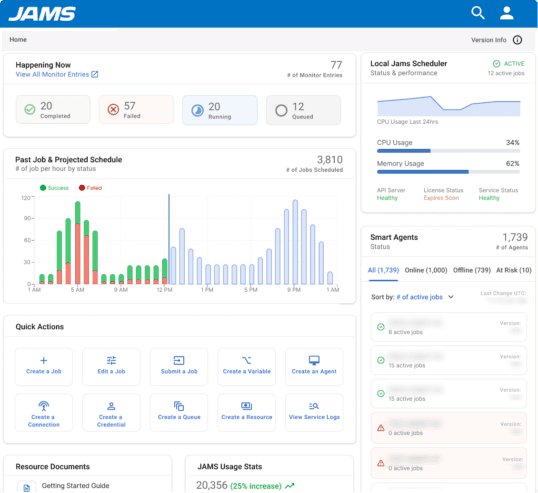
Organizations struggling with disconnected ETL processes, unreliable data transfers, and visibility gaps across hybrid and multicloud environments gain centralized control through a unified platform. Coordinate complex data movements across databases, applications, and APIs—from SQL Server and Oracle to cloud-native services like Azure Data Factory—while providing real-time monitoring, automated error handling, and dependency management. Eliminate manual intervention and scattered scripts that lead to missed SLAs and delayed data.
JAMS automated data pipeline orchestration features provide:
Centralized control: Define and run every job from a single platform, with real-time status visibility.
Event-driven automation: Automate job triggers based on file arrival, API calls, messages, or job completion events.
Proactive monitoring: Leverage alerts and auto-retries to facilitate rapid issue resolution and minimize manual intervention.
Robust compliance: Immutable logs and role-based access control for strong audit trails and secure operations.
Enhanced productivity: Streamline development and management with reusable templates.
Deploy JAMS Data Pipeline Orchestration
Here is a practical sequence for implementing JAMS as your data pipeline orchestration solution.
Initial Setup
Initial Setup
Review these steps for how to set it up:
Install the scheduler: Choose your deployment model — on-premise or in the cloud, on AWS, or on Azure, and follow the installation guide to configure the JAMS database, web client, and thick client.
Plan topology and access: Set up folders, roles, and permissions. Establish naming conventions, parameters, and calendars to maintain consistent definitions and ensure clarity. Also, configure the credential vault to remove hardcoded secrets.
Deploy agents: Install JAMS agents on Windows and Linux hosts that run your jobs and define queues and resources.
Create or Move a Job into JAMS
Create or Move a Job into JAMS
Create or move jobs into JAMS as needed, implementing automation one process at a time:
Configure integrations: Connect built-in integrations, including SAP, SQL databases, Azure Data Factory, PowerShell, and Python. Test connections and capture return codes and logs.
Define jobs: Create job definitions with timeouts, exit code handling, retries, and notifications. Externalize variables and credentials to simplify promotion across environments.
Orchestrate workflows: Build multistep sequences with dependency checking and conditional logic. Add event triggers for files, emails, or API calls so jobs start from real system signals.
Add monitoring and SLA guards: Use centralized monitoring and the diagram view to see workflow state and upstream dependencies. You can configure alerts and diagnostics to surface jobs that may impact SLAs.
Migrate existing schedules: Use the conversion utility to import schedules, exceptions, credentials, and job sources from popular scheduling tools. Review flagged edge cases, such as complex dependencies, and address them with migration services if needed.
Test and Promote
Test and Promote
Run sample workloads in a non-production folder. Inject failures, validate retries and notifications, review run history, and audit entries. Promote to production using consistent names, parameters, and calendars.
Manage Promotion Jobs
Manage Promotion Jobs
To manage promotion jobs:
Tune and promote: Use diagnostics to optimize performance and adjust queues and resource limits. Standardize calendars and maintenance windows to stabilize throughput and reduce noise.
Extend with APIs and MFT: Automate programmatically through the REST API and .NET API. Use the managed file transfer client for reliable file movement within workflows.
Maintain Consistency Throughout the Process
Maintain Consistency Throughout the Process
Reference full documentation and Help Videos for task-by-task guidance. Enroll in JAMS University for training and best practices. Access 24/7 support or professional services when you want expert help.
Why Leading Organizations Choose JAMS
Here is why businesses worldwide partner with us for enterprise job scheduling:
Our PowerShell scripting tools are rigorously tested and trusted by organizations that demand the best, including Raymond James, Coca-Cola Canada, and Teradata.
We consistently transform our users’ operations. G2 reviews highlight JAMS as a “game-changer,” streamlining complex processes and providing “true cross-platform automation.”
Our expert team is available 24/7 to assist you, ensuring your operations run smoothly and efficiently, whenever you need us.

What JAMS Brings to Your Organization
JAMS is a UI-driven data orchestration and workload automation software that delivers rapid value. Here is how organizations benefit: