A game about the job that runs at 2 AM
Dependency Hell: a free browser game about batch job scheduling
You’re the on-call engineer. Twelve nights, a stack of batch jobs, and a window that closes whether you’re finished or not. Place the jobs, respect the dependencies, and hit your SLAs. No signup, no ads, and it works on your phone.
What happens after every level
The same night. Two schedules.
Clear a level, and the game shows you this: the same night, scheduled by hand versus scheduled by JAMS Scheduler. Here it is, before you’ve even played level one.
The premise
Twelve levels, one closing window
Dependency Hell is a free browser puzzle game, made by JAMS Software, in which players build a nightly batch schedule by hand. Each level gives you a set of jobs, the dependencies between them, and a hard batch window. Drag the jobs onto the timeline, press RUN, and watch the night play out. Jobs that start before their upstreams finish don’t fail politely, they slip, and the slip cascades. Levels 1 and 2 hold your hand. Level 5 hands you an FTP job that always runs long. By level 12 you’re doing on paper what an orchestration engine does in a millisecond, which is more or less the point.

Instead of another whitepaper
We wanted people to feel the problem before we explained it
Most of what our industry publishes about batch scheduling is a PDF behind a form. We think the pain is more convincing than the pitch, so we built the pain. Fifteen minutes of hand-placing jobs against a closing window teaches more about why time-based scheduling breaks than any diagram we could draw. When you’ve finished a level, or when you’ve failed one, the game shows you how JAMS Scheduler builds the same night. That’s the whole argument.
How the solver does it
The game runs on a clock. JAMS Scheduler runs on dependencies.
In the game you’re scheduling by time, because that’s the only tool you’re given. You guess how long the extract takes, leave a cushion, and start the load at 1:15. When the extract runs eleven minutes long, the load starts anyway.
Dependency triggers, not time triggers
A job starts when its upstream jobs finish, not when the clock says so. There’s nothing to guess and no cushion to tune.
No drift
Runtimes change with data volume. A dependency-triggered schedule absorbs that. A time-triggered schedule accumulates it until something breaks at quarter end.
No dead air
Every job starts the moment it’s eligible, so the batch finishes as early as the critical path allows rather than as early as your cushions allow.
Failure raises a hand
When a job fails, JAMS Scheduler alerts, holds downstream work, and shows you where the night stopped. It doesn’t run the next twelve jobs against a half-written table.
Bring your own jobs
Build your actual batch night and watch it slip
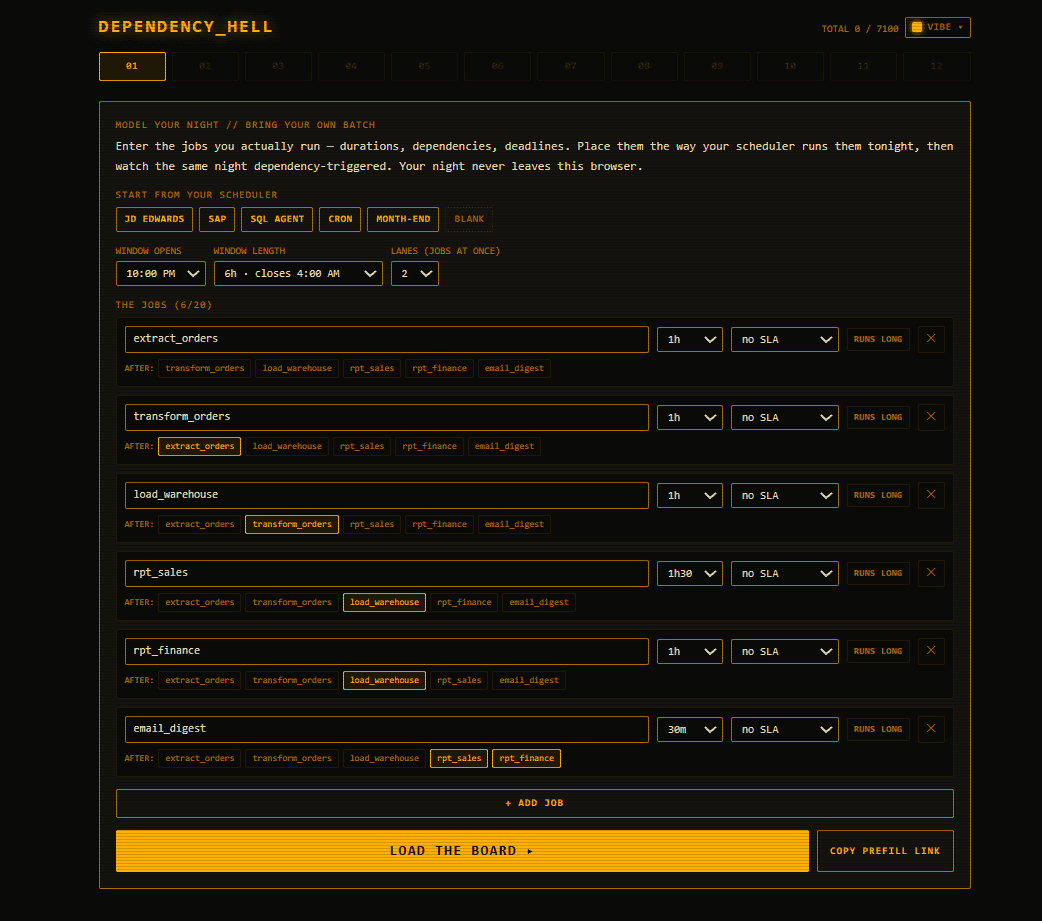
The game ships with a modeler. Enter your own jobs, their dependencies, and your real window, and Dependency Hell will run your night the way it actually runs. Presets are included for cron, Windows Task Scheduler, and SQL Server Agent. You’ll get a report showing where your critical path is, where your slack disappears, and what the same night looks like on dependency triggers.
See it without the ASCII art
The same engine, in the actual product
The solver in the game is a simplified version of what JAMS Scheduler does across Windows, Linux, and Unix, with PowerShell, Python, SQL Server, SSIS, and Azure Data Factory in the same schedule. The interactive tour walks the real interface.
Frequently Asked Questions
Your batch window closes at midnight. Twelve times.
If you haven’t played yet, this is where you start. If you’ve already lost a level to a cascading slip, you already know why we built the thing this page is about.